.svg)

Contact centers are under more pressure than ever. Customers want fast answers and agents need tools that genuinely help them in the moment. Real-time AI assistance changes how both sides experience a conversation. This article walks through what agent assist is, how it works, why it matters now and how choosing the right AI agent assist platform can lift your whole contact center operation.
The Problem Every Contact Center Knows Too Well
Here is a situation that will sound familiar. A customer calls in with a billing issue. The agent can tell straight away it is going to be complicated. They have to jump between three systems, scroll through a knowledge base and try to hold the right policy in their head. Meanwhile, the customer is still on the line. The call drags on. It ends without a clean fix.
That is not a one-off. It plays out thousands of times a day in contact centers around the world. As per industry reports, average handle time consistently ranks among the biggest pain points for operations managers and customers alike. People calling in want a quick, accurate answer. Agents want support that keeps up with the pace of a real conversation.
When those two things are out of sync, quality suffers. That is the gap that AI agent assist software is built to close.
What Is Real-Time Agent Assist?
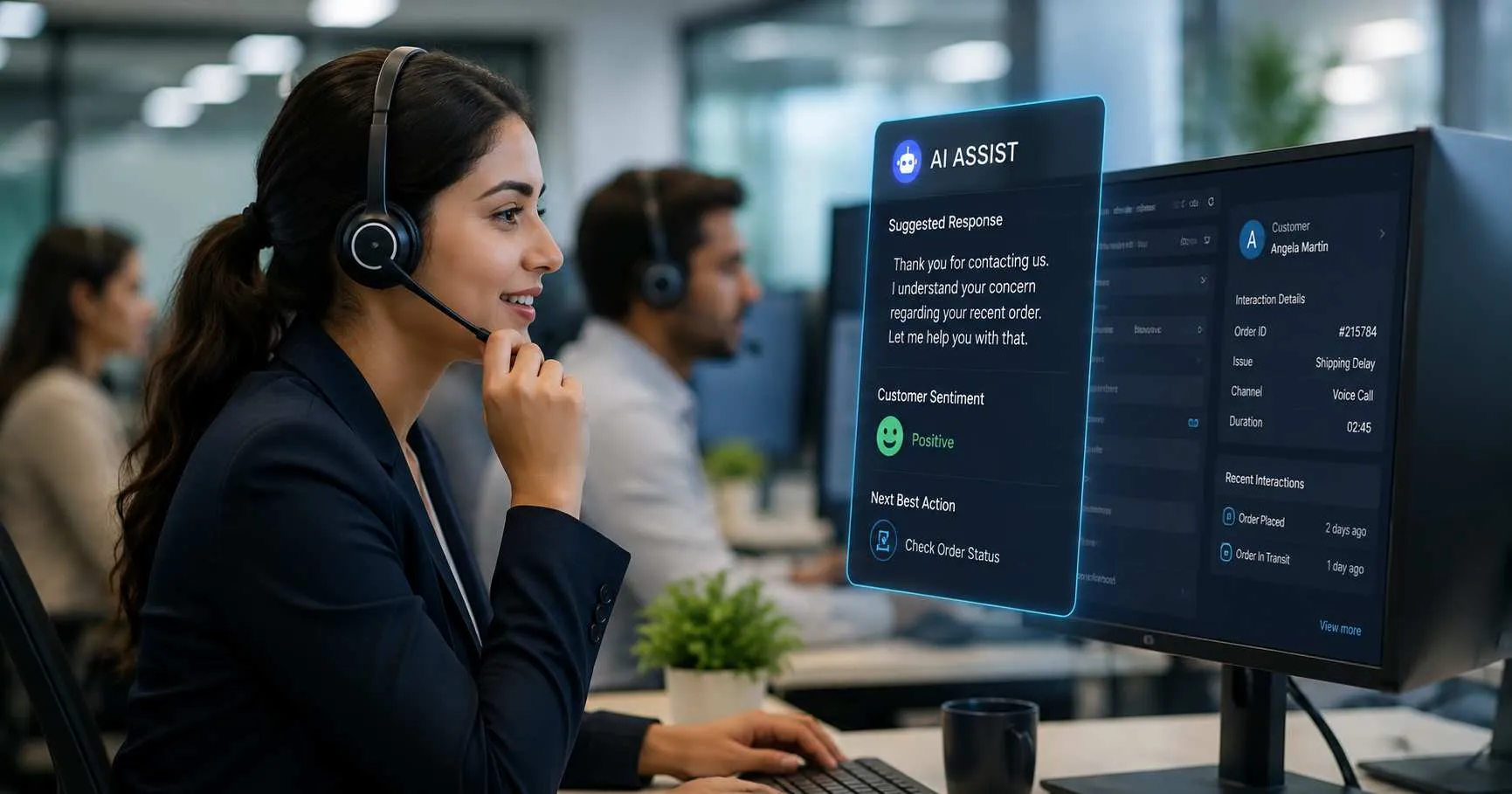
Agent assist is technology that sits alongside a human agent during a live customer interaction. It listens, it processes what is being said and it surfaces the right information without the agent having to go looking for it. Suggested responses, relevant knowledge articles, compliance flags. All of it appears on the agent's screen while the conversation is still happening.
The simplest way to think about it: imagine giving every agent a very experienced colleague sitting next to them on every single call. That colleague has read every policy document, memorised every product update and never has a bad day. That is roughly what good agent assist software delivers.
How It Works in Practice
The AI agent assist tool brings together several technologies working at the same time:
- Speech recognition picks up spoken words and turns them into text with almost no delay.
- Natural Language Processing (NLP) works out what the customer actually means, not just what words they used.
- Intent detection reads the context of the conversation to anticipate what the customer is going to need next.
- Knowledge retrieval automatically finds the most relevant policy, article or answer from your knowledge base.
- Sentiment analysis tracks the emotional tone of the call and gives the agent a heads-up if the customer is getting frustrated.
All of this lands on the agent's screen in real time. No pausing to search. No putting the customer on hold to find an answer. The information comes to the agent, so they can stay focused on the person they are talking to.
Why Real-Time AI Assistance Is No Longer Optional
Real-Time AI Assistance has moved well past the early-adopter stage. Right now, it is becoming a baseline expectation in any well-run contact center. Here is what is driving that shift.
Customers Expect Speed
As per global CX research, a very large proportion of customers expect an immediate response the moment they make contact. When that does not happen, they do not just feel frustrated. Many of them leave. Agents working without real-time support take longer to respond and longer to resolve. That time gap has a direct cost in customer retention.
Agents Are Overwhelmed
Ask any contact center agent what their shift feels like and you will hear the same things. Too many tabs open. Too many policies to remember. Too much expected of them in too little time. Without an AI live support assistant software to share the load, burnout follows. And agent turnover is one of the most expensive operational problems the BPO industry faces.
The Scale Problem in BPO
AI in BPO is no longer a pilot being run by a handful of forward-thinking providers. It is becoming standard operating practice. A large BPO might have agents spread across five continents, handling dozens of different client programs at once. As per expert analysis, trying to maintain consistent service quality at that scale through human oversight alone is simply not viable. An AI agent assist platform gives every agent the same baseline of support, no matter where they are or how long they have been in the role.
Key Benefits of AI Agent Assist Software
Shorter Handle Times
When agents stop having to hunt for information mid-call, conversations move faster. As per industry reports, teams that deploy agent assist software typically see meaningful reductions in average handle time. Shorter calls mean more calls handled per hour. More calls per hour means lower cost per interaction. The maths is straightforward.
Higher First Contact Resolution
Getting it right the first time is what matters most to customers. An agent who has the correct information in front of them during the call is far more likely to resolve the issue without a callback. First contact resolution is one of the most watched metrics in AI customer service and with good reason. When it goes up, the volume of repeat contacts comes down, which saves everyone time.
Better Agent Confidence
New agents often take months before they feel genuinely on top of their role. Meanwhile, experienced agents carry an enormous amount of knowledge that never gets properly documented. An AI agent platform narrows that gap. The guidance a five-year veteran relies on instinct to recall is the same guidance the software surfaces automatically for someone who started last week. That consistency builds confidence and cuts down on avoidable errors.
Improved Customer Satisfaction
When an agent is calmer, quicker and more accurate, the customer feels it. The conversation has less friction. The resolution feels more solid. As per global CX research, contact centers investing in AI customer support consistently report improvements in satisfaction scores and a reduction in escalation rates.
Smarter Compliance
In industries like banking, healthcare and aviation, saying the wrong thing is not just a service issue. It is a regulatory one. The AI agent assist tool monitors the conversation for compliance risks as they happen. If an agent is heading somewhere they should not go, the system flags it before damage is done, not after.
Real-Time Agent Assist vs Traditional Support Models
The table below lays out where traditional contact center models fall short compared to modern AI agent assist software.
How Agentic AI Is Changing the Game
Agentic AI in Customer Experience takes things a step further than surfacing suggested replies. Agentic systems do not just inform the agent. They act. CRM notes updated automatically. Follow-up workflows triggered mid-call. Post-call summaries drafted and ready before the agent has even hung up.
For teams building out their AI in Digital Transformation roadmap, this matters a lot. When the AI is doing the administrative heavy lifting, the agent's role changes. They are not scrambling to keep up with the system anymore. They are the decision-maker and the relationship manager. The AI handles the operational layer underneath.
As per expert analysis, this is one of the clearest drivers of the productivity gains coming out of modern contact centers. In AI in outsourcing and AI in KPO settings, the business case has become very hard to argue against. Fewer errors. Faster resolution times. A measurably lower cost per interaction.
What to Look for in an AI Agent Assist Platform
Not every AI agent assist software tool is built the same way. Some work well in demos and struggle in production. Here is what actually matters when you are evaluating options.
Low Latency
Real-time support only works if it arrives in time. A prompt that shows up two seconds after the agent has already responded to the customer is useless. The best platforms surface guidance with near-zero delay. If a vendor cannot show you latency numbers in a live environment, keep looking.
Deep Integration
The AI customer experience platform has to sit inside the agent's existing workflow, not alongside it as a separate tab they have to remember to check. That means proper integration with your CRM, your telephony stack and your knowledge base. A tool that creates extra steps does not reduce friction. It adds to it.
Intent Understanding
Basic keyword matching is not enough. Two customers can describe the exact same problem in completely different ways. A strong AI agent assist platform understands what the customer means based on the full context of the conversation, not just the last few words. That depth of understanding is what separates a tool that genuinely helps from one that sends the agent down the wrong path.
Sentiment and Escalation Awareness
Some conversations start to go wrong before either party realises it. The right customer experience solutions will track emotional signals throughout the call and alert the agent or a supervisor when the tone shifts. Catching that early is far better than trying to recover after the customer has already asked for a manager.
Analytics and Reporting
Each interaction leaves behind data. A well-designed AI Customer Service Software platform captures that data and turns it into something actionable. Coaching gaps. Knowledge base blind spots. Agents who are consistently struggling with a particular query type. Good reporting makes those patterns visible so managers can act on them.
The Role of AI in BPO and Outsourcing
Here is something worth saying directly. AI in BPO is not primarily a story about replacing agents. The BPOs getting the best results are using AI to make their agents genuinely better at their jobs.
CX automation takes care of the high-volume, low-complexity queries that eat up agent time. That frees human agents to focus on the cases that actually need a person. An AI agent for customer services fills the space between those two worlds, making sure agents have everything they need to handle whichever type of query lands in their queue.
Customer Service Automation Solutions operating at BPO scale need to be genuinely flexible. Different clients have different workflows, compliance requirements and languages. A platform built in a generic environment and then retrofitted for outsourcing rarely holds up. Purpose-built beats adapted, every time.
As per industry reports, BPO providers that have made serious investments in AI agent assist tools are winning more contracts and retaining clients longer. The same pattern holds in AI in KPO environments, particularly where the knowledge demands are high and accuracy cannot slip.
Introducing Prowise by ResolX
Prowise is the AI agent assist platform within the ResolX suite. ResolX is an AI-powered customer experience platform designed for BPOs and enterprise contact centers. The platform combines AI agent assistance with workflow automation and customer engagement capabilities to support service operations.
Prowise provides real-time AI assistance by surfacing relevant knowledge, response suggestions, and contextual information to agents during customer interactions. Because ResolX develops its own technology stack, organizations can manage AI capabilities, integrations, and platform updates within a unified ecosystem.
Prowise is part of the broader ResolX platform, which also includes Omvia for conversation orchestration, Penpal for communication intelligence, and Frequensee for market intelligence. These modules share a common data layer, enabling operational insights across customer interactions and business workflows.
The platform is designed for organizations seeking an integrated AI solution rather than multiple standalone tools. ResolX also holds ISO 42001 certification, supporting organizations with AI governance and management requirements.
Automate the Expertise. Resolve at Scale.
The contact center that works well tomorrow will look quite different from the one that is struggling today. Agents will spend more time actually talking to customers and less time navigating systems to find an answer. Supervisors will spend more time on meaningful coaching and less time on damage control. Customers will wait less and feel heard more.
AI agent assist software enables that shift by helping agents access relevant information more efficiently. For organizations looking for this capability within an integrated AI customer experience platform, Prowise are built for exactly that.
Prowise does not just support your agents. It amplifies them.
Built to solve. Designed to outperform.
Let’s #ResolXIt
FAQ's
1- What is real-time agent assist and how is it different from a chatbot?
Real-Time AI Assistance works in the background, supporting the human agent rather than talking to the customer directly. A chatbot handles the customer-facing side. Agent assist equips the agent with what they need to handle it well. They are complementary tools, not competing ones, and they solve different parts of the service problem.
2- Can agent assist software work with my existing CRM and telephony system?
In most cases, yes. A properly built AI agent assist platform connects with the CRM and telephony infrastructure you are already running. The integration should feel invisible to the agent. The key things to check are latency in a live environment and the depth of the integration, not just whether a connector exists on paper.
3- How does AI agent assist help with agent onboarding?
New agents get in-call guidance from their very first live shift. Rather than spending weeks memorising policies before they are ready to take calls, they learn while they work. The agent assist software fills the knowledge gaps in real time, which shortens ramp time considerably and reduces the chance of early-stage errors that affect the customer experience.
4- Is real-time agent assist suitable for BPO environments?
It is one of the most impactful applications for AI in BPO settings. The scale and complexity of running thousands of agents across multiple client programs makes consistency extremely hard to achieve through supervision alone. AI agent assist software creates that consistency by standardising the quality of support available to every agent, regardless of which desk they are sitting at or which shift they are working.
5- How does AI agent assist software handle compliance requirements?
The strongest AI agent assist tools treat compliance as a live function, not a post-call one. The system monitors conversations as they happen and alerts the agent if something is heading in the wrong direction. For regulated industries where a single misstep can have serious consequences, catching it in real time rather than in a QA review the next day makes a significant difference.