.svg)

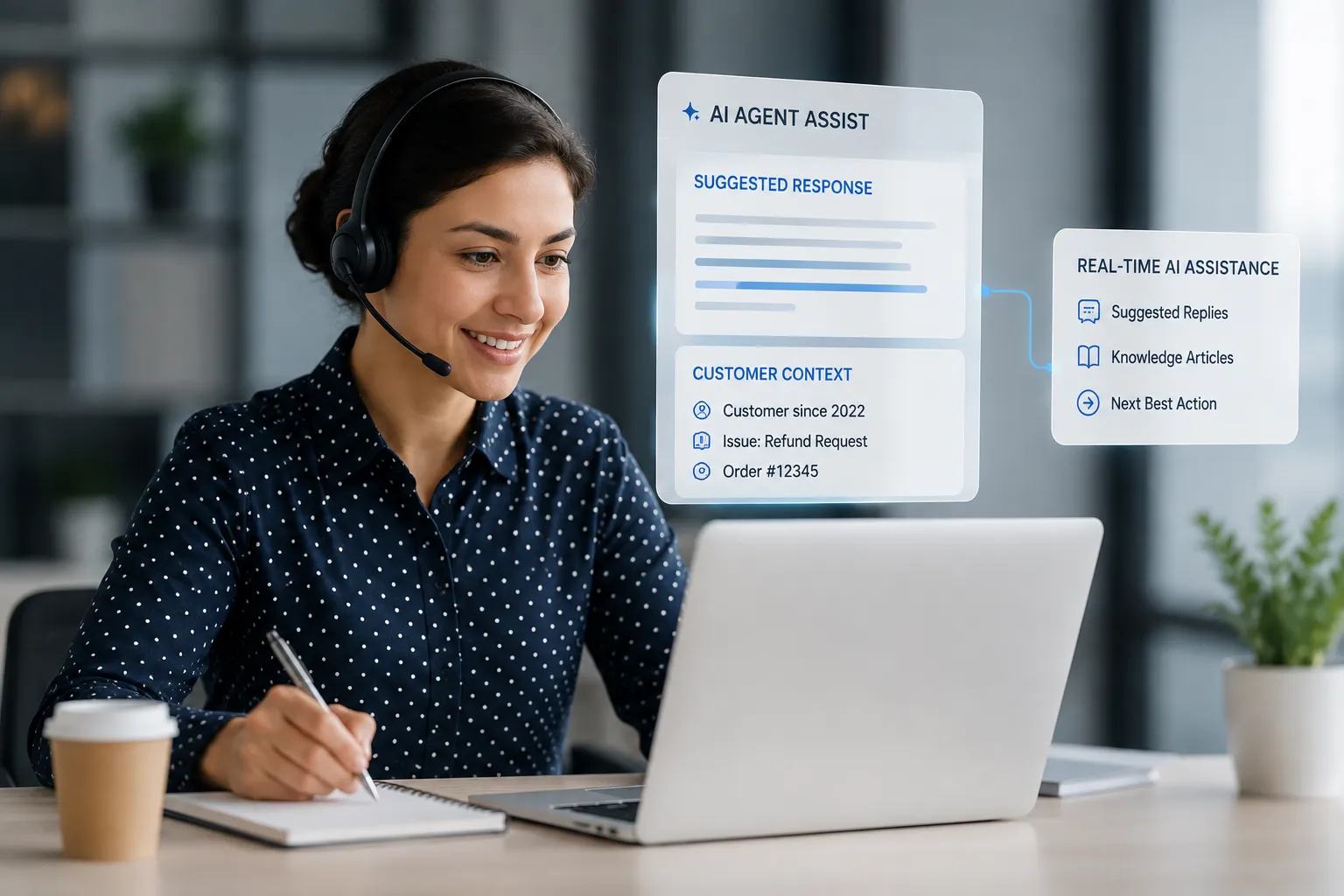
Customers do not remember how a company solved their problem. They remember how it felt to get help. This is why more support teams are turning to agent assist software to close the gap between customer expectations and agent capability.
An agent assists software works alongside your support team in real time. It listens to the conversation and surfaces the exact information an agent needs, right when they need it, instead of leaving them to search or put the customer on hold.
For businesses evaluating how to modernize their support operations, understanding the full capabilities of an AI Agent Assist Platform is a useful starting point.
What Makes Agent Assist Software Different
Traditional support tools were built to store information, not deliver it. Agents had to know where to look and how to interpret long articles under pressure, and that approach breaks down the moment a call gets complicated.
An AI agent assistant flips this model. Rather than making agents search, it brings the right answer to them as the conversation happens, with no lag and no need to place a customer on hold while an agent digs through tabs.
This shift matters because customers can tell the difference between an agent who knows the answer and one who is searching for it. Agent assist technology, whether packaged as software or as a full AI agent assist platform, removes that visible gap so every interaction feels confident.
In practice, most buyers use agent assist, AI agent assist software, AI agent assistant, AI agent assist platform and Real-Time AI Assistance almost interchangeably, so it pays to judge a tool by what it does rather than by its label.
From Static Knowledge Bases to Live Guidance
Static knowledge bases assume an agent has the time and the presence of mind to search mid conversation. In practice, that rarely happens smoothly. A modern AI agent assists software solution removes that assumption entirely by turning your existing documentation and past resolutions into something an agent can use without ever leaving the conversation.
Real-Time AI Assistance in Action
The real value of Real-Time AI Assistance shows up during the conversation itself, not after it. As a customer explains their issue, the system is already working in the background, matching the query against your product data, policies and past resolutions.
This is the model behind Prowise, which operates on what can be described as a zero-step approach. Information appears the moment it is needed, without the agent pausing to ask, search or switch screens. The agent stays present with the customer while the platform handles the retrieval work quietly behind the scenes.
The result is a conversation that flows the way a natural conversation should, with fewer awkward silences and far less dead air. Customers experience an agent who sounds knowledgeable because, in that moment, they effectively are.
Over time, this kind of Real-Time AI Assistance also builds a stronger record of what actually works. Every resolved conversation adds to the pool of guidance the platform can draw on, which means the quality of assistance tends to improve the longer a team uses it.
Faster Issue Resolution, Every Time
Long resolution times are rarely caused by agents lacking effort. They are usually caused by agents lacking access to the right information at the right moment.
Real-Time AI Assistance shortens this distance. By surfacing precise, relevant data as the conversation unfolds, agents can resolve issues in the first interaction instead of escalating or asking the customer to call back. This directly improves First contact resolution rates, which remain one of the clearest indicators of support quality.
Fewer repeat contacts also mean lower support costs and a better experience for the customer, who does not have to explain their problem twice. Trust builds naturally when resolution happens quickly and correctly the first time.
Consistency Across Every Agent
Every support team has star performers, the agents who seem to handle any situation with ease. The challenge is making that level of service the standard rather than the exception.
An AI agent assist platform helps close this gap. New agents can perform closer to experienced ones from their very first shift, because the platform supplies the knowledge that used to take months to build through experience. This reduces the pressure on agents to memorize every product detail or policy update, and it reduces the anxiety that comes with fear of giving a wrong answer.
That reduction in pressure has a real effect on the people doing the work. Reducing agent burnout becomes achievable when agents are not constantly searching under time pressure. Teams that adopt agent assist tools often see steadier performance across shifts, fewer errors during peak volume and agents who stay in their roles longer because the work feels manageable rather than overwhelming.
This is one of the clearest business cases for agent assist software: it turns your best agent's habits into a standard every agent can follow, without asking anyone to memorize a manual.
Agent Assist, AI Agent Assistant and Related Terms
As you research this category, you will come across several overlapping terms. Agent assist software, AI agent assist software and AI agent assistant are often used to describe the same core idea: a system that supports a live agent with information as the conversation happens. Some vendors also use AI agent assist platform to describe a broader, company-wide deployment, while Real-Time AI Assistance usually refers to the live, in-conversation capability itself rather than the platform as a whole.
Understanding these distinctions matters when you are comparing vendors. A narrow AI agent assist software tool might only handle text chat, while a full AI agent assist platform extends Real-Time AI Assistance across voice, chat and email. Knowing which term maps to which capability will help you ask sharper questions during evaluation and avoid paying for features you do not actually need.
Whatever label a vendor uses, the underlying promise of good agent assist technology stays the same: agents get support without breaking their attention away from the person on the other end of the conversation.
In short, whether you call it agent assist software, an AI agent assist platform, an AI agent assistant, or simply Real-Time AI Assistance, the goal stays the same: accurate answers exactly when the conversation needs them, not after it ends.
Choosing the Right AI Agent Assist Software
Not every AI agent-assist solution is built the same way. Some tools only suggest canned responses, while better solutions work directly with your live systems to surface precise, up-to-date information when agents need it.
Compare vendors based on how well their solution performs during real customer interactions, not just how impressive it looks in a slide deck. A short trial using real conversations can tell you far more than a feature list.
When evaluating your options, focus on a few key areas. First, the technology should work in real time without introducing delays that disrupt the conversation. Second, it should connect to your actual data sources rather than relying on static documents that can quickly become outdated. Finally, it should support voice, chat, and other channels without requiring agents to switch between separate tools.
Depending on your operational priorities, related products in this space, such as Omvia for interaction visibility, Frequensee for voice and sentiment insight, or PenPal for written communication support, may complement a core agent assist deployment. The right combination depends on where your team is currently losing time and where customers are experiencing friction.
It also helps to pilot agent assist software with a single team before rolling it out company-wide. A short pilot shows you how agents actually use agent assist in real conversations, which gives you a clearer picture than any product demo.
Businesses that invest in the right AI agent assistant typically see returns beyond the contact center. Faster resolutions and consistent service quality tend to improve retention, referrals and overall brand perception over time.
Conclusion
Customer experience is shaped less by policy and more by moments: an agent understanding a problem right away, a question answered without a hold, a customer feeling heard instead of processed.
Agent assists software creates more of these moments by giving agents the support they need exactly when they need it. It closes the gap between what customers expect and what teams can deliver, without adding complexity to the agent's day.
Our agent assistant tool can also serve as a natural entry point into agentic AI. Once your team trusts AI-generated guidance during live interactions, it becomes easier to extend that trust to systems that can handle simple tasks on their own, such as updating a record or issuing a refund, while keeping a human in control of important exceptions.
Starting with agent assistance today can put your team in a stronger position to adopt agentic AI tomorrow, at a pace that works for your business.
If you are ready to see what a connected, real-time approach to customer support can look like for your team, ResolX brings this capability together as a complete suite. Talk to our team and find out how to get started.
Get in touch at resolx.ai/contact-us
FAQs
1. How is agent assist software different from agentic AI?
agent assist software supports a human agent who stays in control of the conversation. Agentic AI goes a step further and can take actions or complete tasks on its own, with limited or no human involvement. Many teams treat agent assist as the first practical step toward broader agentic AI adoption, since it builds trust in AI generated guidance before handing over more autonomy.
2. Will an AI agent assist platform work with the tools we already use?
Most AI agent assist platform options are built to connect with your existing CRM, ticketing system and knowledge base rather than replace them, so agents get one unified view instead of extra tools to manage.
3. How fast can a team see results from Real-Time AI Assistance?
Many teams see a measurable improvement in resolution time within the first few weeks of using Real-Time AI Assistance, since agents do not need extensive retraining to benefit from it.
4. Is agent assist software worth it for smaller support teams?
Yes. Smaller teams often feel the benefit of agent assist even faster, since a handful of agents can cover far more ground when they are not slowed down by manual searching.
5. Should agent assist software be part of a longer-term agentic AI roadmap?
Most support leaders map their AI agent assist software rollout to a longer agentic AI roadmap on purpose. Starting with an AI agent assistant that supports a human keeps risk low, and it gives you real usage data before layering in agentic AI automation for lower-risk tasks.