A quality analyst opens a call recording that runs for fourteen minutes. She listens, fills in a scorecard and gives the call an 82. It is a careful piece of work, and it tells her almost nothing about the other calls that agent handled this month.
The numbers explain why. Picture a team of 100 agents who each take 500 calls a month. That is 50,000 calls. If analysts review four calls per agent and each review takes fifteen minutes, they cover 400 calls in 100 hours of work, which is less than one percent of the total. Everything else goes unheard. AI quality monitoring exists to change that ratio.
What Is AI Quality Monitoring?
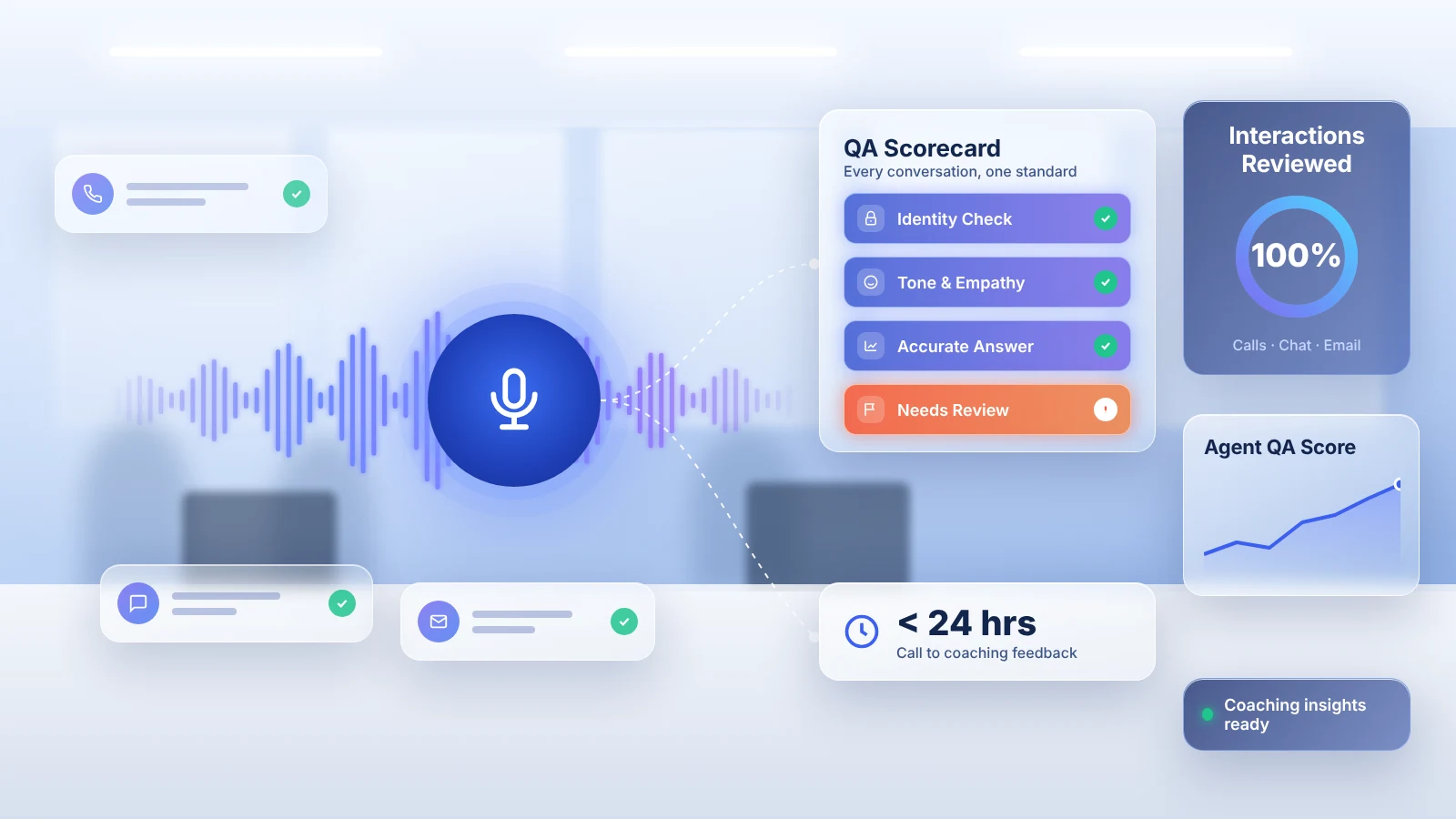
AI quality monitoring uses software to listen to or read every customer conversation, score it against the company's own quality criteria and flag the ones that need attention. It covers calls, chats and emails. In place of a small sample picked at random, the team sees a pattern built from every interaction, and the human reviewers spend their time on the cases that matter.
Think of it as moving from a spot check to a full picture. The analyst does not disappear. The analyst stops hunting for problems and starts acting on them.
Why Does Manual Call Review Miss Quality Issues?
Manual review works well on a small scale, but it runs into the same limits in most contact center quality monitoring programs.
- Coverage is thin, so problems that happen on a few calls a week can stay hidden for months.
- Feedback arrives late, often weeks after the call, when the agent barely remembers it.
- Two reviewers can score the same call differently, which makes scores hard to trust.
- Chat, email and social channels often get less attention than voice.
The last point matters because quality is not only about phone calls. The international standard for customer contact centers covers in-house and outsourced centers of any size, across every inbound and outbound channel, and it defines performance indicators for them.
How Does AI-Powered Quality Assurance Work?
AI-powered quality assurance follows the same logic as a good human review, but it applies that logic to every conversation.
1. Review Every Interaction
Automated call quality monitoring transcribes and analyzes each call, then checks it against a scorecard. Because the work is done by software, adding more calls does not add more reviewer hours in the same way.
2. Score Consistently
The same criteria apply to every conversation, so an agent on the night shift and an agent on the day shift are measured against one standard. This does not remove the need for human judgment, but it does remove much of the drift between reviewers.
3. Find Patterns, Not Just Mistakes
Voice analytics software can show that a certain policy question causes long hold times, or that agents on one team skip a required step. A single reviewer would struggle to see that from a sample. A pattern across thousands of calls is easy to see.
4. Coach the Right Person on the Right Skill
Instead of one training session for everyone, managers can see which agent needs help with empathy, which one needs help with product knowledge and which one already handles objections well.
Where Should AI Quality Monitoring Stop and Human Review Begin?
AI call monitoring should find and score. People should decide. Analysts need to check disputed scores, supervisors need to explain results to agents in a fair way, and leaders need to know how the scoring works. India's central bank makes a similar point about AI in finance: accountability rests with the organization that deploys it.
Agents also deserve to see how they are scored. A monitoring tool that feels like a hidden camera will earn resistance. One that feels like a coach will earn use.
A Realistic Example
A contact center runs a payments helpline. Under manual review, an analyst hears twelve calls from one team in a month and finds nothing unusual.
With AI quality monitoring for contact centers, the system scores every call from that team. Within a week it shows that on the evening shift, agents often skip the step where they confirm the customer's identity before sharing account details. The supervisor listens to a handful of the flagged calls, confirms the issue and runs a short session with that shift. Next week's scores show whether the habit changed. Nothing in this story needed a bigger QA team.
What Should You Check in an AI Quality Monitoring Tool?
Contact centers comparing AI-powered quality assurance tools should ask:
- Does it review all channels, or only recorded voice calls?
- Can the team set its own scorecard, or must it use a fixed template?
- Can a reviewer see the exact moment in the conversation behind each score?
- Does it separate agent coaching from simple compliance checking?
- Can agents see their own results and raise a dispute?
How Do You Measure AI Quality Monitoring Results?
Good contact center quality monitoring shows up in numbers the team already tracks:
- The share of interactions reviewed, which should rise sharply
- The time between a call and feedback to the agent
- Agent QA score trends across shifts and teams
- Repeat contacts on the same issue
- Customer satisfaction scores
- Reviewer hours spent per reviewed interaction
Compare these with a baseline from before launch. A monitoring program that improves coverage but not coaching has only produced better reports.
How Frequensee Fits Into This Workflow
Frequensee is ResolX's AI-powered conversation quality and audit platform. It analyzes interactions at scale to support workforce coaching and market/product intelligence. In a published case study, a leading Indian life insurer increased voice audit coverage from about 20% to about 80%, with feedback within 24 hours and escalations reduced to zero during the reported period.
The platform goes beyond error spotting. ResolX says it identifies the language and behaviors used by the top five percent of performers so other agents can learn from them, and that it finds the skill gap for each agent instead of relying on blanket training. It also links interaction behavior to measures such as CSAT and NPS.
For leaders who need AI agent performance monitoring that feeds into coaching, that combination is the useful part. Teams should still test the scoring on their own calls before they trust it.
Conclusion
A sample of one percent was never a full picture of service quality. It was simply what a manual process could afford. AI quality monitoring gives contact centers a way to hear every conversation, score it fairly and coach agents on real evidence, while analysts keep the final say. Teams that adopt automated call quality monitoring with clear scorecards and open results often find that the biggest change is cultural: quality stops being something that is checked after the fact and becomes part of how the team improves each week.
FAQs
1. What Is The Difference Between AI-based Review and Manual Call Reviews?
Manual reviews check a small sample of calls, usually after a delay. Software scores every conversation against the same criteria and flags the ones that need a person to look. The two work best together, with software finding the cases and people judging them.
2. How Does Automated Call Quality Monitoring Score A Call?
It transcribes the conversation, then checks it against a scorecard the team has set, such as greeting, identity checks, accurate answers, tone and a correct close. It produces a score and points to the moments behind it, so a reviewer can verify the result quickly.
3. Can AI Call Monitoring Replace QA Analysts?
No. It removes much of the listening work, but analysts still handle disputed scores, calibrate the scorecard and turn findings into coaching. Their role moves from sampling calls to guiding agents and improving the process.
4. Does AI Quality Monitoring For Contact Centers Work For Chat And Email?
It can, if the tool supports those channels. Customers move between voice, chat and email, so a program that only reviews phone calls leaves large gaps. Ask vendors which channels they cover before you buy.
5. How Do You Know Automated Monitoring Is Working?
Look for higher coverage, faster feedback and steadier agent scores, then check whether repeat contacts and customer satisfaction improve too. If scores rise but customers do not notice, the scorecard probably needs a rethink.